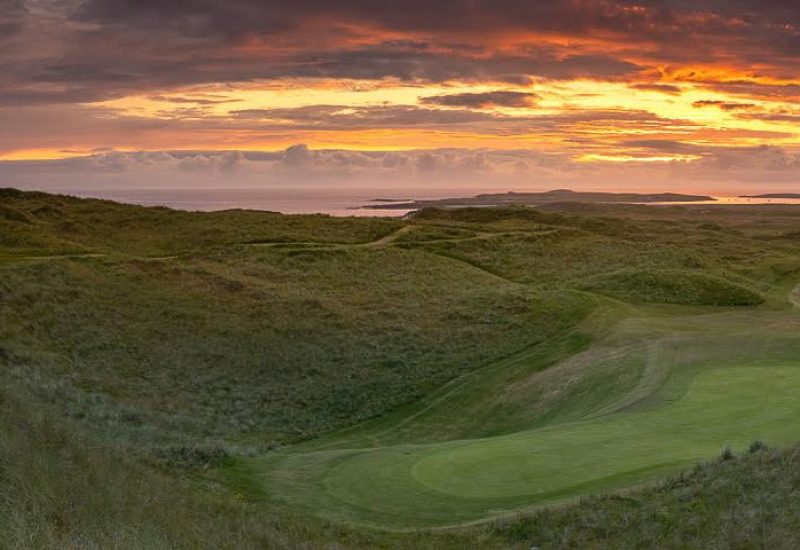
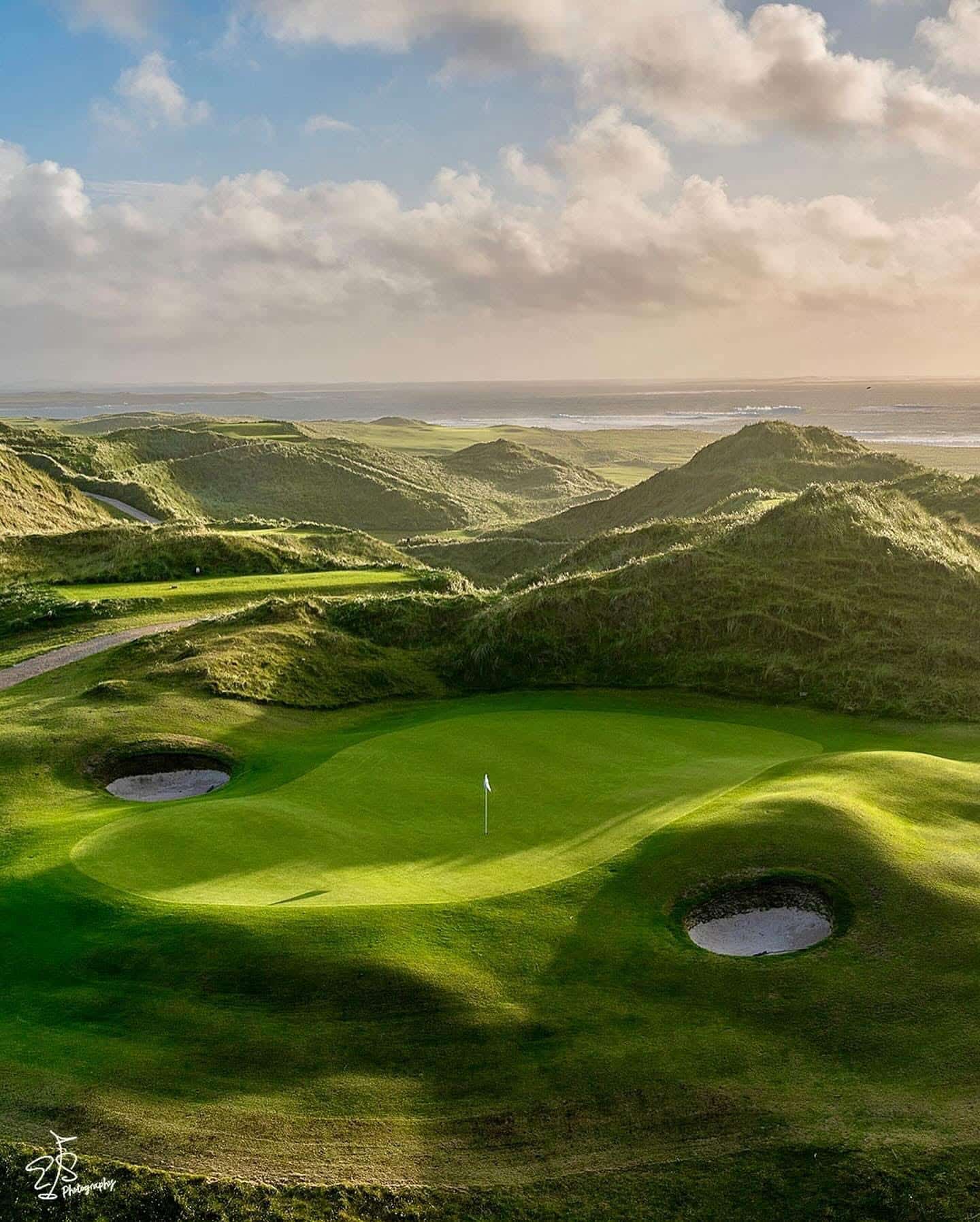
“When you motor up the Ballina Road, through the tidy Irish village of Béal an Mhuirthead (a.k.a.Belmullet), past McDonnells Bar & Undertakers, through the Main Street roundabout, and up around the tip of Blacksod Bay, you get a glimpse of what awaits you at Carne Golf Links several miles before you reach the car park. Dunes. Gargantuan dunes. Brobdingnagian dunes. Epic, grassy summits – some as tall as 12 storey buildings – that lie across the linksland like sleeping giants who’ve overindulged in Guinness. This remote County Mayo section of western Ireland’s Wild Atlantic Way is celebrated for its dramatic headlands and silvery strands where surfers share the shoreline with sandpipers. But for the travelling golfer, few sights herald more drama than that which unfolds on 27 prodigious holes.
Carne’s rugged, natural links were developed on a shoestring budget beginning in 1989. With tourism in mind, the local nonprofit organisation that owns and operates the course acquired 220 acres of farmland and invited Irish course designer Eddie Hackett to create the original 18. The fetching first nine of the Hackett course occupies gentler ground before its second ushers you high into sandhill heaven. Nine additional holes, the Kilmore nine, were routed through the site’s most imposing dunes in 2013.
Some lean times followed, and Carne had to weather a series of economic downturns that would’ve forced less determined souls to shutter the operation. But, in time, that new nine, which allowed for the creation of a second, composite 18, put Carne on the world golf map and made it a destination unto itself. They named the new course Wild Atlantic Dunes, and wild it most certainly is, both in the profound naturalness of its seaside setting and the giddy exuberance you feel as you step onto each tee.
The Wild Atlantic Dunes expedition begins at the uphill-then-downhill-then-uphill-again par-five 1st, where the fairway splits two lower-level dunes before culminating at a wide, sloping green backstopped by a mountain of marram. From the moment you crest that first rise, you begin to feel small – as insignificant against the sheer scale of Carne as one of its visiting tortoiseshell butterflies. Moments later, though, when you reach the sky-high 2nd tee, you’re king of the hill, as the enormity of Carne’s supersized dunes comes fully into view and you contemplate a steeply downhill tee shot en route to an elevated green you cannot yet see.
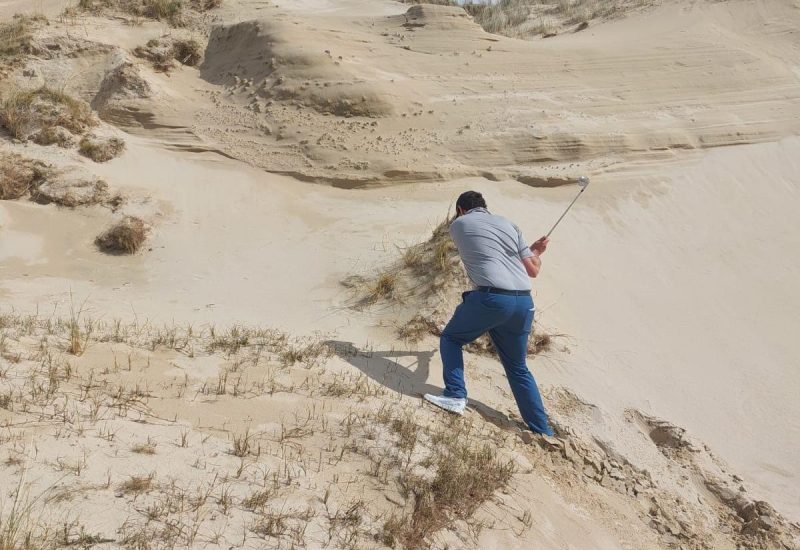
As much as this vertigo-inducing landscape factors into playing the course, its charms don’t end there. Hackett’s design work, including on the less tumultuous nine, is masterful, yielding one stirring challenge after another. And the towering Kilmore nine, completed from Hackett sketches by Ally McIntosh and Jim Engh, elevates the excitement level even higher, bother literally and metaphorically. Very little earth was moved here. It didn’t need to be. The natural dells and hilltops where the green sites sit, the valleys and ridges that define the margins of the knobby fairways, the sand pits that attract wayward orbs like black holes – they were all largely here, just waiting for golf to employ them.
Edward Burns shot a soon-to-be-released feature film at Carne in 2024, Finnegan’s Foursome, about two bickering brothers who go on a trip to scatter the ashes of their Irish golf-pro father. A bench that figures into the story still sits beside the 10th tee. It’s an ideal spot to pause and take in the splendors of Carne before finishing your round and joining its snoozing giants in a Guinness of your own.”